


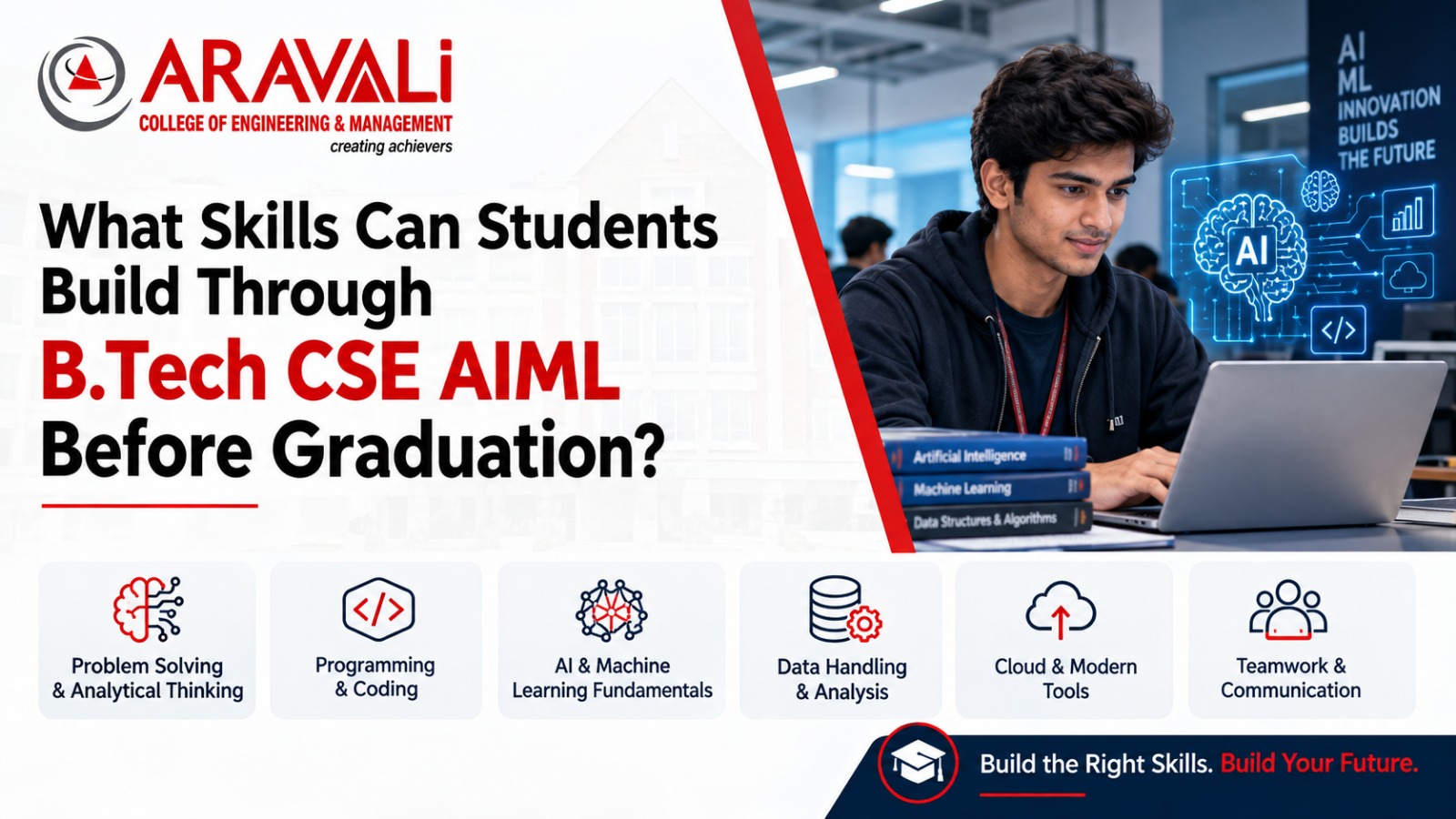
What Skills Can Students Build Through B.Tech CSE AIML Before Graduation?
A B.Tech CSE course, specializing in Artificial Intelligence and Machine Learning, can be an appropriate course for students to cultivate skills in programming, data analysis, artificial intelligence, machine learning, problem-solving, communication, and developing projects even before completing the degree program. This type of learning is best achieved by going beyond theoretical learning to practical coding assignments, data sets, AI projects, internships, hackathons, and problem statements in the industry. Through a B.Tech AIML college in Delhi, students will gradually be able to develop these skills in preparation for a career as an AI/ML engineer, data analyst, software developer, AI application developer, and many other technology professions.
Key Points
- Basics of programming provide a good basis for learning AI and software engineering.
- One can learn how to work with data, algorithms, and machine learning systems.
- Projects in AI can help one translate theoretical knowledge into practical use.
- Coding and projects promote the development of problem-solving skills and analytical thinking.
- Communication and collaboration skills are important for technology careers.
- Internships and hackathons can improve career preparedness.
- A good AIML course should blend computer science basics and modern technologies.
What Skills Does B.Tech CSE AIML Help Students Develop?
Programming and Computational Thinking
Programming is one of the first skills students need to develop because AI and machine learning applications depend heavily on computational logic.
Students can build proficiency in languages such as Python while also strengthening their understanding of data structures, algorithms, object-oriented programming, and software development principles.
These foundations matter because advanced AI tools cannot replace the need to understand how software works.
Data Handling and Analysis
AI systems depend on data. Students therefore need to understand how data is collected, cleaned, structured, analysed, and interpreted.
Through coursework and projects, students can learn concepts related to databases, statistics, data preprocessing, visualisation, and exploratory analysis. These skills can be useful across AI, analytics, software, and data-oriented roles.
How Does AIML Education Build Practical AI Skills?
Machine Learning Model Development
Machine learning involves teaching systems to identify patterns and make predictions from data. Students can learn supervised and unsupervised learning concepts and understand how different algorithms are selected for different problems.
Practical assignments can involve building models, evaluating their performance, identifying limitations, and improving results.
This gives students a clearer understanding of what happens between a theoretical algorithm and a functioning application.
Artificial Intelligence and Deep Learning
As students progress, they can explore more advanced areas such as neural networks, deep learning, natural language processing, computer vision, and intelligent systems.
The objective is not simply to learn technical terminology. Students should understand where these technologies are useful and how they can be incorporated into real applications.
Aravali College of Engineering and Management lists Computer Science & Engineering in Artificial Intelligence & Machine Learning among its B.Tech offerings, and its prospectus notes that the CSE department introduced B.Tech AI & ML in 2020.
Key Factors That Strengthen AIML Skill Development
Strong Computer Science Fundamentals
Students should not choose an AI-focused program only because AI is popular. A strong foundation in computer science remains essential.
Important areas include:
- Data structures and algorithms
- Programming
- Database management
- Computer networks
- Operating systems
- Software engineering
- Object-oriented programming
These subjects create the foundation on which specialised AI and ML skills can be developed.
Hands-On Projects
Projects allow students to combine multiple skills. Instead of learning Python, statistics, databases, and machine learning separately, students can use them together to create a working solution.
Examples could include recommendation systems, predictive models, image classification applications, chatbots, or data-analysis dashboards.
Exposure to Emerging Technologies
AI is evolving quickly. Students benefit from exposure to current tools, frameworks, cloud platforms, generative AI concepts, and responsible AI practices.
However, technology exposure should complement—not replace—fundamental learning.
Benefits / Advantages
Better Problem-Solving Ability
AI development is essentially problem-solving. Students must understand a problem, identify useful data, select an appropriate approach, test their solution, and interpret the results.
This process develops structured thinking that can be useful well beyond technology roles.
Stronger Project Portfolio
A graduate with several meaningful projects can demonstrate practical capability more effectively than someone whose experience is limited to academic examinations.
Students can document projects on portfolios or professional platforms, explaining the problem, technology used, methodology, and outcome.
Greater Career Flexibility
A combination of CSE fundamentals and AIML skills can provide exposure to multiple technology pathways. Depending on their interests and additional skills, graduates can explore software development, machine learning, data analytics, AI engineering, automation, and related roles.
Improved Teamwork and Communication
Technology projects are rarely completed by one person in professional environments. Students who participate in group projects, hackathons, presentations, and technical competitions learn to communicate ideas and collaborate effectively.
Common Challenges Students Should Avoid
Focusing Only on AI Tools
Using an AI tool does not automatically mean understanding AI. Students should learn the underlying concepts and limitations of the technologies they use.
Ignoring Mathematics and Statistics
Machine learning involves probability, statistics, linear algebra, and related mathematical concepts. Students who avoid these foundations may find advanced ML topics more difficult.
Building Projects Without Understanding Them
Copying a project from an online tutorial may produce a working application, but it does not necessarily build expertise.
Students should understand why each technology was selected, how the system works, and what could be improved.
Waiting Until the Final Year
Skill development should begin early. A student who starts programming, projects, internships, and competitions only during the final year has less time to experiment and improve.
How Can Students Make the Most of a B.Tech AIML Program?
Build Skills Progressively
During the first year, students can focus on programming and computational fundamentals. Later, they can progress toward data handling, machine learning, AI applications, and larger projects.
Participate in Hackathons and Competitions
Hackathons encourage students to solve problems within limited time and collaborate with peers. They can also expose students to technologies and problem statements outside the classroom.
Seek Internship and Industry Exposure
Internships can help students understand how development teams work and how technical skills are applied in professional environments.
Aravali College of Engineering and Management’s placement information highlights internships and live projects as part of its industry-oriented career preparation, alongside pre-placement training and industry connections. Create a Meaningful Project Portfolio
By graduation, students should ideally have projects that demonstrate different capabilities rather than several versions of the same basic application.
A balanced portfolio might include:
- One strong software development project
- One data analytics project
- One machine learning project
- One AI-focused application
- One collaborative or industry-oriented project
Expert Perspective / Practical Insight
What Should an AIML Student Be Able to Do Before Graduation?
The goal should not be to master every AI technology. Instead, students should graduate with the ability to understand a problem and determine how technology can help solve it.
A capable graduate should be able to write and understand code, work with data, select suitable algorithms, evaluate model performance, troubleshoot problems, explain technical decisions, and collaborate with others.
This is also why students comparing B.Tech AIML colleges in Delhi should examine more than the course title. They should look at laboratories, project-based learning, faculty expertise, internships, technical events, industry interaction, and opportunities to work with emerging technologies.
The distinction between learning about AI and learning to build with AI can have a meaningful impact on a student’s professional readiness.
Frequently Asked Questions
1. What skills can students learn in B.Tech CSE AIML?
Students can develop programming, data analysis, machine learning, artificial intelligence, database, algorithmic thinking, software development, problem-solving, and communication skills.
2. Is coding important for an AIML career?
Yes. Programming is a fundamental skill for developing, testing, implementing, and maintaining AI and machine learning applications.
3. Do AIML students need mathematics?
Yes. Mathematics and statistics support important areas of machine learning, data analysis, optimisation, and model evaluation.
4. Why are projects important for AIML students?
Projects help students apply theoretical concepts to practical problems and demonstrate their ability to build and evaluate technology-based solutions.
5. Should students do internships before completing B.Tech AIML?
Internships can provide valuable workplace exposure and help students understand how technical concepts are applied in professional environments.
6. How should students choose a B.Tech AIML college?
Students should consider curriculum quality, computer science fundamentals, AI/ML coursework, practical projects, laboratories, faculty, internships, industry exposure, placement preparation, and opportunities for technical competitions.
Final Thoughts
A successful AIML graduate is not defined simply by knowing the latest AI tool. The stronger advantage comes from combining programming fundamentals, data skills, machine learning knowledge, analytical thinking, project experience, and the ability to solve practical problems.
For students evaluating a B.Tech AIML college in Delhi, the right institution should provide opportunities to develop these skills progressively through classroom learning, projects, technical activities, internships, and industry exposure. Aravali College of Engineering and Management offers B.Tech CSE in Artificial Intelligence & Machine Learning as part of its engineering programs, with its CSE department focused on application-oriented and industry-relevant learning.
For an aspiring AI professional, starting early and consistently turning concepts into working projects can make the difference between simply completing a degree and graduating with skills that are ready to be applied.