


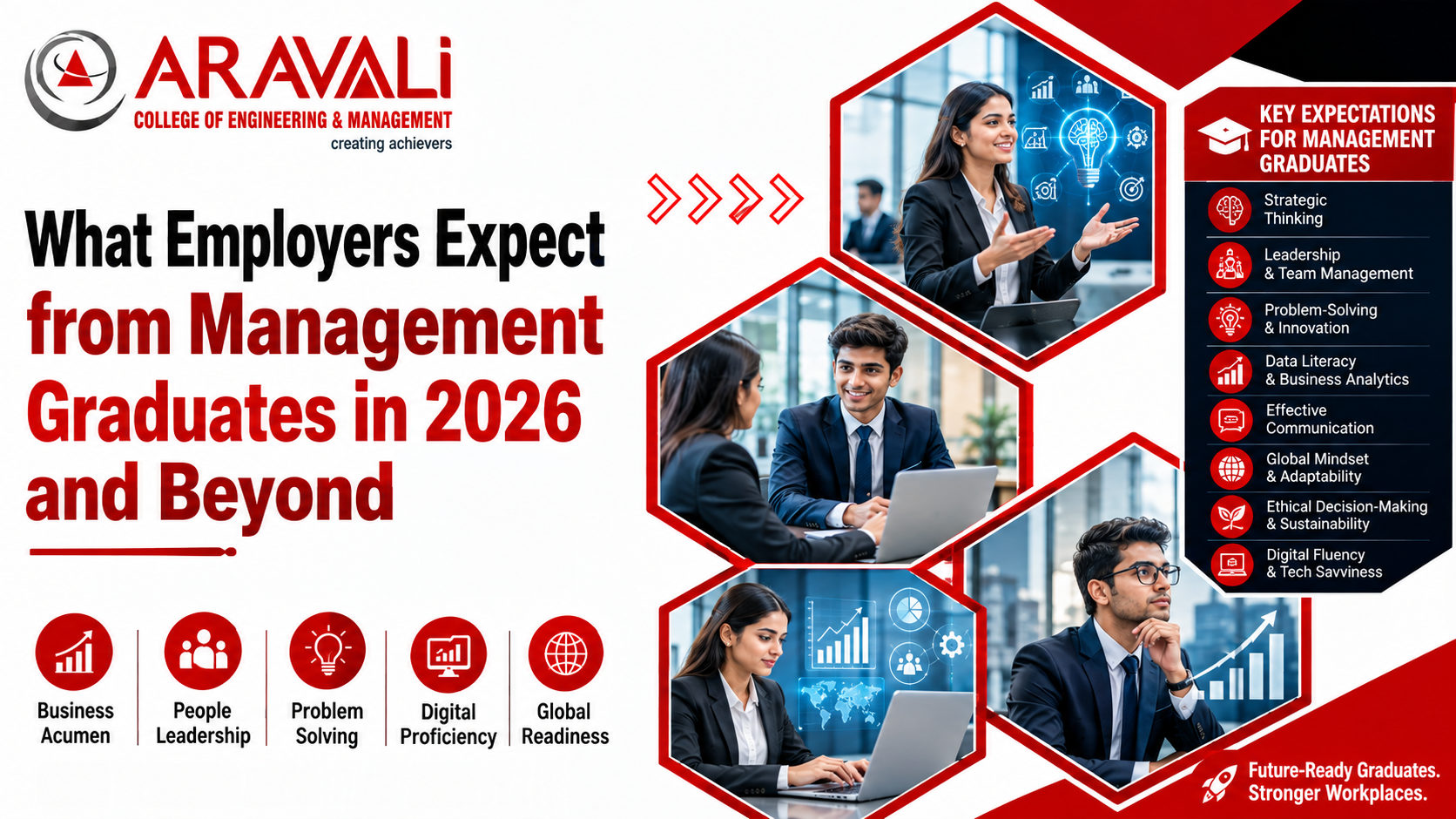
What Employers Expect from Management Graduates in 2026 and Beyond
When a management student graduates in the year 2026, he is stepping into a completely different kind of business world compared to what their peers studied ten years ago. Recruiters today do not just want candidates with the ability to discuss management theories or score well in examinations. They look for people with the skills to analyze data, express their thoughts, apply technology, deal with novel problems, and adapt when business situations change.
So when students plan to study BBA or MBA, the question that comes to mind is: what exactly makes a person an employable individual upon completion of their studies?
This is exactly where the amalgamation of academic education, experience, digital competence, communication skills, and professional judgment comes into play. This also explains why the selection of the Best Management College in Delhi needs more than just considering ranks and infrastructure.
Why Employer Expectations Are Changing in 2026
Roles within the business world are transforming due to factors such as artificial intelligence, automation, analytics, digital platforms, globalization, and evolving customer behavior. Even the roles of management are becoming technology-oriented.
For example, the marketing graduate has to know about digital marketing campaigns and customer data. The finance professional has to deal with analysis and automated reporting. HR is increasingly relying on technology in recruiting, engagement, and talent planning.
Thus, employers require people with knowledge both in business and technology.
Consequently, the Best Management College in Delhi needs to prepare students for current business practices by providing them with experience in modern business operations rather than just learning in the classroom.
The Shift from Degrees to Demonstrable Skills
A degree remains an important qualification, but employers also want evidence that graduates can apply what they have learned. This can come through internships, live projects, presentations, case competitions, simulations, research assignments, and industry interactions.
Students who can explain how they solved a real business problem often have an advantage over those who can only describe textbook concepts.
This shift makes employability a shared responsibility between the student and the institution. Colleges provide the environment and opportunities; students must actively use them to build professional capability.
Which Skills Do Employers Want from Management Graduates?
Modern employers generally look for a combination of technical, interpersonal, analytical, and strategic skills. No single skill guarantees career success, but a balanced skill set can make graduates considerably more adaptable.
1. Analytical and Critical Thinking
Management professionals regularly work with incomplete information and competing priorities. Employers want graduates who can evaluate information, identify patterns, question assumptions, and make logical recommendations.
Students can strengthen this ability through business cases, data interpretation exercises, research projects, and practical assignments.
2. Communication and Presentation
A strong business idea has little value if it cannot be communicated effectively. Management graduates need to write clearly, present confidently, participate in meetings, and communicate with different stakeholders.
Presentation-based learning helps students become comfortable explaining ideas in professional settings.
3. Digital and AI Awareness
Technology is now part of almost every business function. Students do not necessarily need to become software developers, but they should understand how digital tools and AI can support research, analysis, marketing, operations, finance, and decision-making.
A future-ready management curriculum should encourage responsible and practical use of technology.
4. Problem-Solving and Decision-Making
Employers value people who can move from identifying a problem to evaluating possible solutions. Real business projects are particularly useful because they introduce constraints that theoretical questions often do not capture.
5. Teamwork and Collaboration
Corporate work rarely happens in isolation. Graduates may collaborate with people from marketing, finance, technology, operations, and human resources.
Group projects and multidisciplinary activities help students learn how to manage responsibilities, resolve disagreements, and work toward shared objectives.
Proof & Real-World Perspective
Why Practical Learning Makes Graduates More Job-Ready
Consider two students applying for a business development role. Both understand sales theory. However, one has completed a project involving customer research, prepared a sales presentation, analysed competitors, and presented recommendations to a panel.
The second student can demonstrate not only knowledge but also application.
This distinction matters during recruitment because interviews often explore how candidates respond to situations rather than simply testing definitions.
Similarly, an HR student who has worked on an employee engagement project can discuss practical challenges more confidently. A finance student who has analysed a company can demonstrate greater familiarity with financial information.
For this reason, students evaluating the Best Management College in Delhi should examine the extent to which practical learning is integrated into the academic experience.
What Industry Exposure Can Add
Industry exposure can include:
- Internships and workplace projects
- Corporate guest lectures
- Industry visits
- Business case competitions
- Management workshops
- Live consulting assignments
- Entrepreneurial projects
- Professional networking opportunities
These experiences can help students understand workplace expectations before they begin their first full-time role.
Analysis
Why Employability Requires More Than Academic Performance
Academic performance demonstrates discipline and conceptual understanding, but professional success requires a broader combination of capabilities.
A management graduate may have excellent marks yet struggle with presentations, teamwork, workplace communication, or practical decision-making. Another student with balanced academic and extracurricular experience may demonstrate stronger professional readiness.
This does not mean academic performance is unimportant. Instead, employers increasingly look at the complete profile.
The Most Valuable Combination for Future Managers
The strongest management graduates are likely to combine:
- Business fundamentals
- Analytical thinking
- Digital literacy
- Communication skills
- Practical experience
- Adaptability
- Leadership capability
- Ethical decision-making
This combination allows graduates to move between changing responsibilities and industries while continuing to learn.
Common Mistakes Students Should Avoid
Students can weaken their career preparation by focusing exclusively on examinations or waiting until the final year to think about employment.
Other common mistakes include:
- Choosing a college only because of its reputation
- Ignoring internship opportunities
- Avoiding public speaking and presentations
- Treating technology as optional
- Building a resume without meaningful experiences
- Neglecting professional networking
- Assuming a degree automatically guarantees placement
Career preparation should begin early and develop throughout the academic journey.
Recommendations
How Should Students Choose a Future-Ready Management College?
Students comparing institutions should evaluate the actual learning environment rather than relying only on promotional claims.
A useful checklist includes:
- Does the curriculum reflect current business practices?
- Are internships and live projects available?
- Do students regularly interact with industry professionals?
- Are communication and leadership skills developed?
- Does the institution provide career guidance?
- Are students exposed to digital tools and emerging technologies?
- Does the college encourage entrepreneurship and innovation?
- What opportunities exist for practical business learning?
The Best Management College in Delhi for one student may not necessarily be the institution with the highest ranking. The better choice is the college that aligns academic learning with the student’s career goals and provides consistent opportunities to develop workplace-ready capabilities.
Students Also Need to Build Their Own Professional Profile
College resources are valuable, but students should take ownership of their development.
They can begin by completing relevant certifications, participating in competitions, attending industry events, building professional profiles, completing internships, and developing a portfolio of meaningful academic or business projects.
Small experiences accumulated over several years can create a much stronger professional profile than last-minute preparation.
Closing Thoughts
Employers in 2026 and beyond are looking for management graduates who can think critically, communicate clearly, understand technology, collaborate effectively, and apply business knowledge to real situations. The traditional model of learning concepts and reproducing them in examinations is no longer enough to prepare students for every workplace challenge.
Choosing the Best Management College in Delhi should therefore involve a careful assessment of curriculum quality, industry exposure, practical learning, faculty expertise, career preparation, and opportunities for personal development.
Aravali College of Engineering and Management can support aspiring management professionals through an education focused on academic foundations, practical exposure, professional development, and career readiness. For students planning a career in business and leadership, selecting an institution that develops both knowledge and capability can be an important first step toward long-term professional growth.