


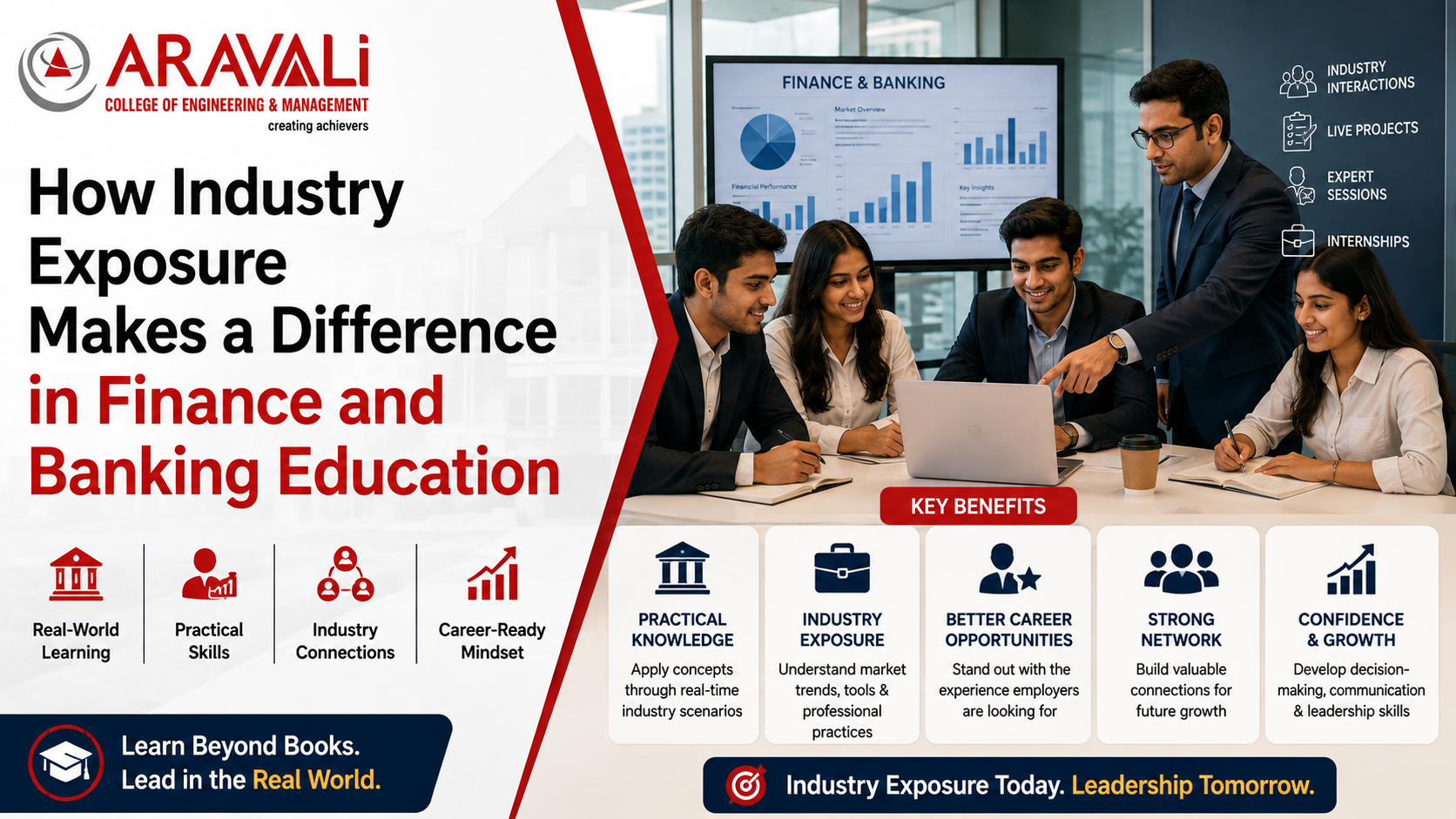
How Industry Exposure Makes a Difference in Finance and Banking Education
For example, two graduates are going for the same job at a bank. Both are equally good academically, but one graduate is someone who has gained practical experience working on live financial projects and interacting with banking professionals. Clearly, the employer will see more potential in the graduate with practical knowledge, as they have seen the operations of the industry from the inside out.
This is a common situation now. More and more employers are looking for people who can add value immediately; hence, Finance and Banking Education becomes more important.
Industry Insight
Why is Industry Exposure Reshaping Finance and Banking Education?
The finance sector is transforming at an unprecedented pace. Financial technology, banking, fintech, AI-driven financial services, blockchain, and data analysis are revolutionizing the way banks and other financial institutions function. This trend has created a need for employees who have knowledge not just about financial ideas but also of their practical application in business contexts.
Modern Finance and Banking Education addresses this transformation through the introduction of internship programs, project work based on real business situations, corporate mentoring, industry tours, and case studies in the curriculum. All this prepares students to link theory with practice in a rapidly transforming financial environment.
An industry-focused education program has become a key characteristic of those institutions that seek to train professionals who can tackle real financial issues.
Expert Commentary
How do Finance and Banking Education Build Career-Ready Professionals?
Experienced educators and banking professionals agree that successful finance careers require much more than academic excellence. Students must develop analytical thinking, communication skills, ethical decision-making, and the confidence to work in dynamic business environments.
A high-quality Finance and Banking Education program should emphasize:
- Practical financial analysis
- Banking operations and compliance
- Investment and wealth management
- Risk assessment
- Financial technology applications
- Customer relationship management
- Business communication
- Strategic decision-making
Industry mentors often recommend that students actively participate in internships, financial workshops, certification programs, and corporate networking events. These opportunities provide insights that cannot always be gained through classroom lectures alone.
Graduates who combine technical knowledge with practical exposure are better prepared for leadership roles in the financial sector.
Proof & Real-World Perspective
Learning Beyond the Classroom Creates Stronger Finance Professionals
Many leading educational institutions now collaborate with banks, NBFCs, insurance companies, investment firms, and fintech organizations to provide students with practical exposure throughout their academic journey.
For example, students participating in live banking simulations learn how loan approvals, customer relationship management, compliance checks, and financial risk assessments are handled in actual organizations.
Similarly, internships allow students to observe:
- Banking operations
- Credit analysis
- Investment planning
- Financial reporting
- Customer advisory services
- Digital banking platforms
These experiences improve professional confidence while helping students understand workplace expectations before graduation.
Rather than entering their first job with only theoretical knowledge, students begin their careers with a clearer understanding of industry practices.
Analysis
The Long-Term Benefits of Industry-Oriented Finance and Banking Education
Industry exposure offers significant advantages that extend well beyond securing the first job. It shapes professional thinking and prepares students for continuous career growth.
Some of the key benefits include:
| Traditional Learning | Industry-Oriented Learning |
| Focuses primarily on theory | Combines theory with practical application |
| Limited exposure to workplace challenges | Hands-on experience with real business situations |
| Classroom-based assessments | Live projects and professional assignments |
| Academic confidence | Professional confidence |
| Knowledge acquisition | Career readiness |
Students pursuing Finance and Banking Education with strong industry integration often demonstrate better problem-solving abilities, improved communication skills, and greater adaptability in corporate environments.
However, students should avoid assuming that internships alone guarantee career success. Continuous learning, certifications, networking, and skill development remain equally important throughout their professional journey.
Recommendations
Choosing the Right Finance and Banking Education for Long-Term Success
Selecting the right institution requires careful evaluation beyond brochures and rankings. Students should focus on programs that prioritize practical learning alongside academic excellence.
Before making a decision, consider the following checklist:
- Strong industry partnerships
- Internship opportunities with reputed organizations
- Experienced faculty with industry backgrounds
- Corporate guest lectures and workshops
- Live financial projects and case studies
- Placement support and career mentoring
- Updated curriculum covering fintech and digital banking
- Professional certification opportunities
Students should also explore alumni success stories and placement records to understand how effectively an institution prepares graduates for the financial industry.
Choosing an industry-oriented program significantly improves employability and career progression.
Closing Thoughts
The finance sector continues to evolve with technological innovation, changing regulations, and growing customer expectations. As organizations seek professionals who can combine financial expertise with practical business understanding, industry exposure has become an essential part of modern education.
A well-designed Finance and Banking Education program equips students with analytical abilities, professional confidence, and real-world experience that employers increasingly value. Institutions such as Aravali College of Engineering and Management emphasize industry-oriented learning through practical training, internships, corporate interactions, and career-focused education. By choosing a program that blends academic knowledge with real industry exposure, students can build a strong foundation for long-term success in banking, finance, and financial services.